It’s the day after the 55th Annual Boskone Convention wrapped up, and I just realized I haven’t written a post for some time. To commit my thoughts and observations in the “permanent” annals of the internet, I thought I’d talk about my experience at my very first writing convention. I met and heard from some amazingly talented authors, editors, and agents in the fantasy and science fiction genre.
What Is Boskone?
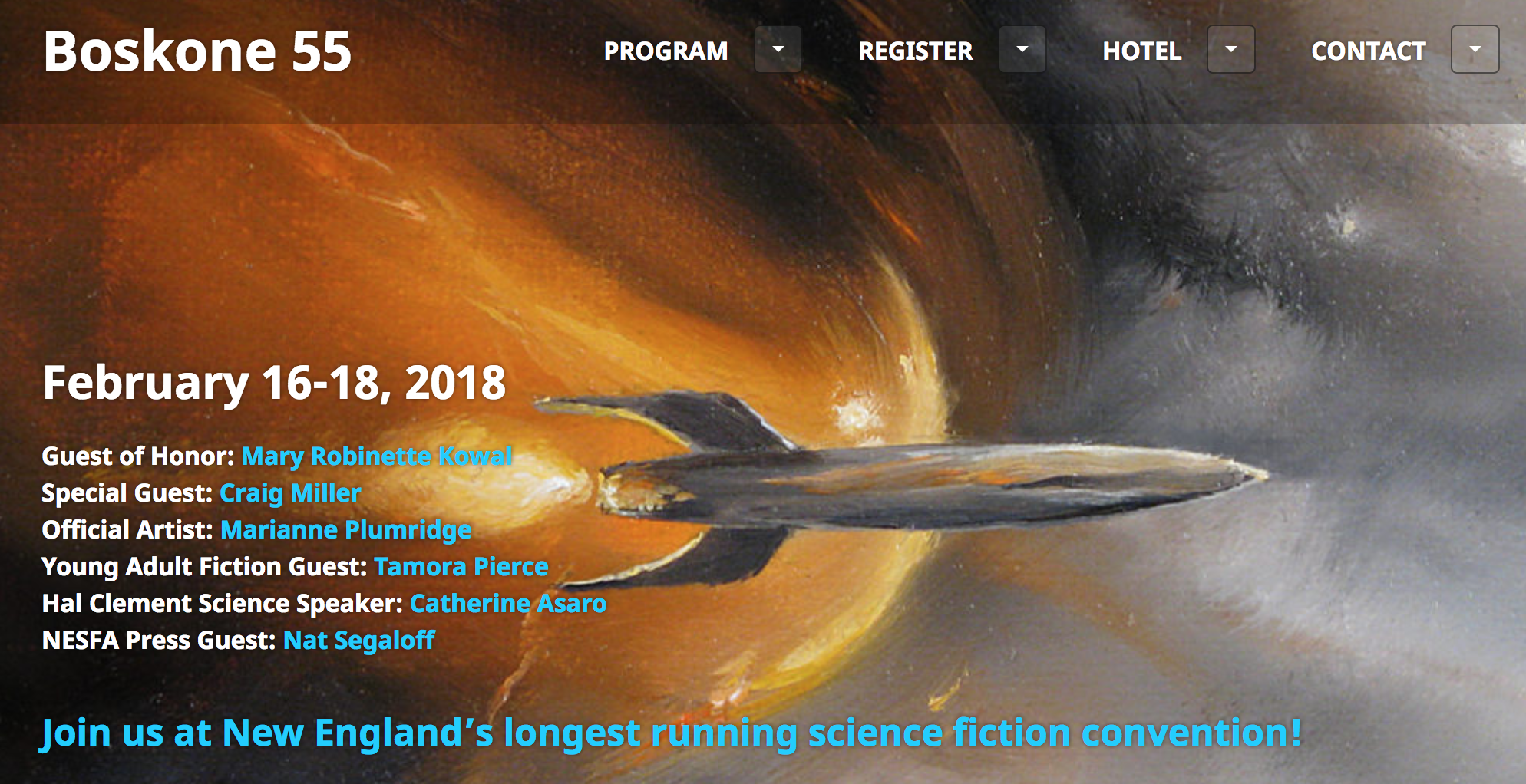
No one I knew had ever heard of Boskone and, truth be told, neither had I until my Fantasy and Science Fiction professor at Lesley University told me about ReaderCon, which happens every summer in Quincy, Massachusetts. In researching that, I stumbled upon Boskone. Right there on the homepage, I saw enough to get me to register: Mary Robinette Kowal and Tamora Pierce.
Mary–the charismatic co-host of my favorite podcast, Writing Excuses, and Tamora–one of the best YA fantasy writers ever! Done. I’m there.
Then, I kept finding bonuses as I perused the long list of program participants. I kept getting more and more excited, but I really had no idea what to expect. I’ve never been to a writing convention before. Heck, I’ve never been to any kind of convention before.
In early January, they posted the schedule for the weekend, and I started picking out which panels I most wanted to go to. Odin knows, I had trouble choosing. More often than not, several fascinating panels were happening at the same time. I kept having to remind myself that this wasn’t the one and only convention I’d ever get to attend in my life. No, this was just the first (of many, I hope).
Where was Boskone?
You can click the link for their website, but I’ll tell you that, at least for this year, it took place at the Westin Boston Waterfront hotel, right next door to the Boston Convention Center. Boskone was in the hotel, though, not over in the convention center. The New England Boat Show was happening over there.
The Westin was beautiful… what I saw of it. I didn’t stay there. Living just 30 miles north, I couldn’t justify spending $200+/night for a room when I could walk and train it to and from for $15.00 a day. But, based on some of the hotel patrons I observed while sitting in the lobby wishing I was better at striking up conversations with people, I’m willing to guess their rooms were equally beautiful.
Boskone events occupied all the conference and banquet rooms in the hotel’s east (north?) wing on all three floors, which were reasonably sized and clean. I was impressed with the quality of the mic systems the hotel provided for the event. The shrink wrapped carpets in the Galleria (in and around where snacks were put out each evening) amused me.
The Social Scene
To all you people who go to conferences more often than I do, or who are perhaps published authors who attend conventions as participants: how do you talk to each other?! I’m not referring to asking questions during panel discussions. That’s easy because that’s a venue with limits and expectations and rules for conduct, etc. I’m talking about striking up casual social conversations that might allow me to actually meet other established or aspiring authors.
I spent most of my time between panel discussions watching groups of people mingle and chat and laugh with each other. I saw so many authors in the halls with whom I desperately wanted to strike up a conversation, but all I could do was smile and manage to whimper out a feeble “hello.” How do you all do it?! I’m in awe and completely jealous of folks with, you know, social skills.
Is there some secret handshake I don’t know about? Do the folks who attend conventions all know each other from elsewhere? Same for the authors; do they all know each other already?
Friday evening, there was an art show and refreshments opening event that I went to. My beloved went with me for moral support and to see the art. At one point, we were standing up on an elevated level that looked down on the rest of the floor, packed with people. And everywhere I looked, people were sitting together at tables or standing in clusters with authors mixed in. All happy, all chatting. I felt very much like an outsider, but I just couldn’t must the courage to march up to a bunch of people I didn’t know and start talking.
I randomly struck up a conversation with K. Stoddard Hayes while looking at beautiful art, but she was alone and we were admiring the same painting simultaneously. She was so nice, by the way! My claim to fame is now that I lent K. Stoddard Hayes a pen so she could bid on a painting at Boskone. Great as that was, I can’t hope for that kind of happy random encounter over and over again!
Event Highlights for Me
 Okay, I’ll start with the two people who initially drew me to the convention: Mary Robinette Kowal and Tamora Pierce. I did get Mary Robinette Kowal to sign my copy of Ghost Talkers (fantastic book), and struggled to form coherent words and sentences while talking to her at the autograph table. Hope I didn’t come off as too much of a bumbling weirdo.
I also got to listen to Mary’s Guest of Honor interview (she was interviewed by an Astronaut, by the way. I’m not kidding!). She is articulate and well-spoken (shocker since she’s an audiobook narrator as well as author and professional puppeteer) and charismatic and genuine. She even broke out one of her puppets during the interview! Her parting thoughts at the end will stay with me for a long time. “Don’t be ashamed of your voice.”
 I was not able to get my copy of Tempest and Slaughter signed by Tamora Pierce, sadly. The line was ridiculously long and I naïvely thought that if I just slipped out of the “Ensemble Casts and Continuing Characters” discussion panel at 4:40, I’d have 20 minutes to get down to her autographing session and get my book signed. Pshaw right!
Ah, well, as I kept reminding myself and will continue to remind myself, this was just the first writing convention I’ve been to, not the only one I’ll ever go to. At least I got to hear her talk about her thoughts regarding sex in YA fiction. Her thoughts (and I’m paraphrasing): what’s the big deal? It happens. She was smart and funny!
The art, people. Thor Almighty the art! Absolutely fantastic. Jaw-droppingly good stuff. I didn’t take pictures, because I feel a bit dodgy about posting photos of someone else’s art online without getting explicit permission, and most of the artists weren’t around during the multiple times I ambled through the galleries. You’ll just have to take my word for it. The art was amazing.
The panels were incredible, too, and I wish I could have gone to them all, but alas, I haven’t yet managed to steal the Time Turner. Anyway, here are some of the great takeaways that I jotted into my notebook during various panels:
“The teen libedo longs to escape and run free. That’s just a biological reality.” – Darleen Marshall during the It’s Not Always About Sex panel.
During the Sex and Romance in YA Fiction panel, Barry Goldblatt said there’s a strange hierarchy of what kind of sex on the page is okay and what isn’t. Rape? Fine. Masturbation? Deal breaker. I find that utterly bizarre! What does that say about our culture in America that we’re okay letting teens read about sex that’s violent and painful and damaging but not a sexual act that is safe and pleasurable and private?
“If you want your secondary characters to be memorable, you have to give readers something to remember!” – Kenneth Schneyer during the Ensemble Casts and Continuing Characters panel.
“All the members of an ensemble think they’re the protagonist and they all get time on the stage to show their story.” – E.C. Ambrose during the Ensemble Casts and Continuing Characters panel.
During the Governmental Structures in SFF panel, Nik Korpon pointed out that SFF authors tend to gravitate toward totalitarian/dictatorial/monarchist systems of government because they’re easy to write, and I understood what he meant, but then Susan Jane Bigelow pointed out that in reality, those structures are inherently fragile and difficult to maintain and so the systems created by those in power to hold onto their power are actually incredibly complex. All the panelists agreed and agreed that authors rarely address much beyond the big, bad overlord villain and his closest henchmen.
“Agents want to see what’s there ‘in the rough’ for a manuscript. They want to see what you produced, not what you and a professional editor produced.” – Richard Shealy during the What Good is an Agent panel.
“My agent works for an agency that gets 40,000 queries each year. So, don’t get discouraged if you don’t land an agent in the first 10, 20, 100 queries.” – Hillary Monahan during the What Good is an Agent panel.
During the Forgotten Topics in YA panel, the panelists all listed off topics that they didn’t see being addressed in YA fiction but needed to be: non-romantic formative relationships, interracial couples, and voices of the impoverishes/severely disenfranchised.
“The Ultimate theme of all YA stories is Person versus Self (coming of age stories).” – Carlos Hernandez during the Forgotten Topics in YA panel.
“Each book needs to be a story in its own right, with its own compelling arc, but each book also needs to fit into the multi-book arc of the series.” – Marshall Ryan Maresca during the Ending a Series panel.
Those were just a few of the many gems that caught my attention.
I’m not sad it’s over. I’m happy it happened.
Sure, but I’m still a little sad it’s over because while I heard from and (in very rare circumstances) spoke to and connected via twitter with a bunch of interesting and talented people at Boskone this past weekend, there were many more with whom I didn’t.
I’ve already go my sights set on ReaderCon in July of this summer.
Here are all the folks who struck me as particularly cool people, which is not to say that all the other participating authors/agents/editors/etc aren’t also cool people; I just didn’t get a chance to experience them this time around.
- Kristy Acevedo
- E.C. Ambrose
- Susan Jane Bigelow
- Joshua Bilmes
- J. Kathleen Cheney
- John Chu
- Andrea M. Corbin
- Theodora Goss
- Carlos Hernandez
- J.A. Holderman
- Walter H. Hunt
- Alexander Jablokov
- Gregory Scott Katsoulis
- Nik Korpon
- Bracken MacLeod
- Marshall Ryan Maresca
- Darlene Marshall
- Hillary Monahan
- Steve Popkes
- Suzanne Reynolds-Alpert
- Kenneth Rogers Jr.
- Ken Schneyer
- Vandana Singh
- Juliana Spink Mills
- Richard Shealy
- Michael Stearns
- EJ Stevens
Final Thoughts
I am so happy that I decided to push myself outside my comfort zone and attend a writing convention. I’m even more happy that my first experience with a writing convention was Boskone.
If you get a chance, you should get to Boskone56 next year. You won’t be disappointed. It’s the longest running fantasy and science fiction convention in New England and worth traveling to experience. Maybe I’ll see you there!
Did you attend Boskone55? If so, what was a highlight moment for you?

 This month’s